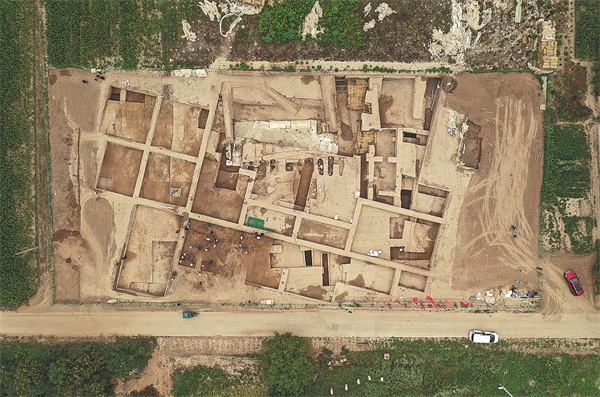
Nanzuo Site
Introduction
The Nanzuo Site is an ancient archaeological site located in Nanzuo village on the Dongzhi Plateau in Qingyang city, Gansu province, Northwest China. Dating back approximately 4,700 to 5,200 years, the Nanzuo Site is a significant relic of the Neolithic period, covering an estimated area of 600 hectares. As part of the broader Yangshao Culture, which thrived along the middle reaches of the Yellow River, the site offers invaluable insights into the early formation of Chinese civilization.
The history of the Nanzuo Site is deeply intertwined with the Yangshao Culture, which flourished between 5,000 and 7,000 years ago. This culture is recognized for its remarkable contributions to the early development of Chinese civilization, particularly in terms of agriculture, social structure and cultural advancements.
Archaeological Excavations
The Nanzuo Site's archaeological significance was initially recognized during a national survey of cultural relics in 1958, although it did not gain substantial attention until multiple archaeological excavations were conducted in the 1980s and 1990s. The site houses a large settlement with a central palace complex, characterized by a central axis and evenly distributed rammed earth terraces, akin to later imperial architectural styles.
In recent years, a new wave of archaeological investigations has provided substantial insights into the Nanzuo Site's historical importance. Multidisciplinary methods have been employed to uncover the site's intricate layout and cultural relics. The excavations have revealed the site's role as a high-level settlement, possibly functioning like a capital in its time. The core area, encircled by nine terraces and spanning 30 hectares, features a central palace-like complex with a strict architectural layout.
Recent discoveries include exquisite pottery, tools, ornaments and the perplexing presence of carbonized rice, suggesting advanced agricultural practices or trade connections. These findings underscore the site's role as a significant cultural and political hub during the late Yangshao Culture, contributing to our understanding of early Chinese civilization.
Cultural Significance
The Nanzuo Site holds profound cultural significance, offering a glimpse into a well-organized and functioning society during the Neolithic period. Its architectural layout, with a central axis and evenly distributed terraces, mirrors the design of later dynastic capitals and palaces, indicating a sophisticated level of urban planning and social organization. The discovery of cultural relics, such as white and black pottery, stone and bone tools and red arrowheads, suggests a complex social structure with rituals and ceremonies, possibly linked to early theocratic or monarchical governance. The site's role as a probable capital or central settlement highlights its importance in the development of early Chinese civilization, reflecting a period of cultural exchange and unity in diversity.
Artifacts
Pottery
The pottery unearthed at the Nanzuo Site is of particular interest due to its exquisite craftsmanship and cultural implications. Notably, the site has yielded white and black pottery, some as thin as eggshells, demonstrating advanced pottery-making techniques. The presence of kaolin, a rare raw material on the Loess Plateau, further emphasizes the uniqueness of these artifacts. The black pottery potentially links the site to the Qujialing Culture, suggesting trade routes or cultural exchanges between regions. These pottery pieces, likely used in rituals and sacrifices, offer valuable insights into the site's religious and cultural practices.
Tools
The Nanzuo Site has also provided a wealth of tools made from stone and bone, offering a glimpse into the technological and practical aspects of the Neolithic society. These tools include arrowheads, which are thought to have played a role in ceremonial or military contexts. The discovery of red arrowheads covered with cinnabar aligns with historical records from later dynasties, where red arrows symbolized military power. The variety and craftsmanship of these tools reflect the site's advanced technological capabilities and its significance as a hub of social and political power.
Ornaments
In addition to pottery and tools, the Nanzuo Site has revealed a collection of ornaments that highlight the aesthetic and cultural values of its inhabitants. Among these are turquoise beads and other decorative items, which likely held symbolic or ritualistic significance. The craftsmanship of these ornaments demonstrates the society's appreciation for beauty and artistry, as well as its access to resources and trade networks. These findings contribute to our understanding of the cultural and social dynamics at play during the site's occupation.
Preservation Efforts
Efforts to preserve the Nanzuo Site and its artifacts are ongoing, with a focus on safeguarding its historical and cultural heritage for future generations. Archaeologists and researchers continue to collaborate with institutions such as the Gansu Provincial Institute of Cultural Relics and Archaeology and Renmin University of China to ensure the site's protection and study. Advances in digital technology, including virtual reality and 3D modeling, are being harnessed to create detailed records and reconstructions of the site's structures and artifacts. These preservation efforts aim to maintain the integrity of the Nanzuo Site while allowing for continued research and exploration of its historical significance.








